

-
1 relation degree
Юридический термин: степень родства -
2 relation degree
-
3 relation degree
-
4 relation
rɪˈleɪʃən сущ.
1) отношение;
зависимость, касательство, связь causal relation ≈ причинная связь to establish relation ≈ установить связь, отношение in relation to Syn: dependence
2) повествование, изложение;
описание, рассказ;
сообщение;
отчет Syn: narration, narrative
1., recital, account
1. ;
report
1.
3) юр. изложение фактов;
представление информации, заявление в суд;
донос
4) а) родство( кровное или возникающее в результате брачных отношений) Syn: kinship б) родственник;
родственница Syn: relative, kinsman, kinswoman ∙ relation degree ≈ степень родства blood relation, natural relation ≈ кровное родство;
кровный родственник collateral relation ≈ побочное родство, боковая линия родства;
побочный родственник half-blood relation ≈ полукровный родственник (единокровные или единоутробные братья или сестры) legitimate relation ≈ родство, признаваемое законом lineal relation ≈ родство по прямой линии no relation ≈ никакого отношения, никакого родства ( при отрицании существования какого-л. родства при совпадении фамилий)
5) мн. отношения (связи между кем-л., чем-л., образующиеся в процессе общения, какой-л. деятельности) to break off, sever relation ≈ разорвать отношения to break off diplomatic relation with a country ≈ разорвать дипломатические отношения со страной to cement, improve, promote, strengthen relation ≈ укрепить, улучшить отношения to have, maintain relation ≈ поддерживать отношения to normalize relation ≈ нормализовать отношения to renew relation ≈ возобновить отношения to strain relation ≈ испортить (натянуть) отношения - public relations business relations close relations commercial relations trade relations diplomatic relations economic relations extramarital relations friendly relations foreign relations international relations intimate relations labor relations marital relations premarital relations race relations sexual relations strained relations troubled relations отношение, связь, зависимость - * of forces соотношение сил - the * between weather and crops зависимость урожая от погоды - the * of time and space соотношение времени и пространства - to bear no * to smth. не иметь никакого отношения к чему-л. - to bear not much * to smth. иметь весьма отдаленное отношение к чему-л. - to be out of( all) * to не иметь никакого отношения к - to plan with * to the future планировать с расчетом на будущее - to have * to smth. иметь связь с чем-л., относиться к чему-л. - to make * to smth. ссылаться на что-л. - in /with/ * to что касается;
относительно( специальное) соотношение, формула, уравнение обыкн. pl отношения - strained *s натянутые отношения - international *s международные отношения - commercial *s торговые связи - foreign *s внешние сношения - diplomatic *s дипломатические отношения - to enter into diplomatic *s вступить в дипломатические отношения - to break off diplomatic *s порвать дипломатические отношения - *s of production (политика) (экономика) производственные отношения связь, контакт - the * between mother and child связь между матерью и ребенком (эвфмеизм) половое сношение повествование, изложение;
рассказ, описание, история - the * of one's adventures рассказ о своих приключениях родственник, родственница - near * близкий родственник - he is no * to me он мне не родственник - * on the mother's side родственник со стороны матери - * by marriage свойственник;
родственник мужа или жены (юридическое) представление информации, заявление в суд( редкое) родство (геология) условия залегания( компьютерное) отношение - ordering * отношение порядка;
способ упорядочения action ~ отношение действия antireflexive ~ антирефлексивное отношение antisymmetric ~ антисимметричное отношение antitransitive ~ антитранзитивное отношение binary ~ бинарное отношение blood ~ кровный родственник business ~ деловой контакт causal ~ причинная связь cause-effect ~ причинно-следственная связь constraint ~ соотношение для ограничений debtor-creditor ~ отношения между кредитором и дебитором empiric ~ эмпирическое соотношение equivalence ~ отношение эквивалентности extensional ~ экстенсиональное отношение external ~s вчт. внешние связи relations: external ~ внешние сношения feedback ~s отношения обратных связей functional ~ функциональное отношение fuzzy modelling ~ нечеткое отношение моделирования group ~ взаимоотношения между членами коллектива ~ редк. родство;
in relation to относительно;
что касается in ~ to относительно in ~ to что касается indifference ~ отношение равноценности industrial ~s трудовые отношения в промышленности;
Industrial Relations Act антипрофсоюзный закон "Об отношениях в промышленности" relations: industrial ~ внутрипроизводственные отношения industrial ~ отношения в процессе труда industrial ~ отношения между администрацией и рабочими в промышленности industrial ~ производственные отношения, трудовые отношения industrial ~ связи между промышленными предприятиями и общественными учреждениями industrial ~ трудовые отношения между администрацией и профсоюзами industrial ~s трудовые отношения в промышленности;
Industrial Relations Act антипрофсоюзный закон "Об отношениях в промышленности" intensional ~ интенсиональное отношение inverse ~s обратная зависимость inverse ~s обратная пропорциональность it is out of all ~ to, it bears no ~ to это не имеет никакого отношения к it is out of all ~ to, it bears no ~ to это не имеет никакого отношения к linear ~s линейная зависимость marital ~ супружеские отношения non-reflexive ~ нерефлексивное отношение nonlinear ~s нелинейная зависимость obligatory ~ обязательное изложение фактов ordering ~ отношение порядка price ~ соотношение цен recursion ~s рекуррентные соотношения reflexive ~ рефлексивное отношение relation взаимоотношение ~ взаимосвязь ~ зависимость ~ заявление в суд ~ изложение ~ изложение фактов, представление информации, заявление в суд ~ отношение, связь ~ отношение;
связь, зависимость;
relation of forces соотношение сил;
relations of production полит.-эк. производственные отношения ~ отношение ~ повествование, изложение;
рассказ ~ повествование ~ представление информации ~ родственник, родственница ~ родственник;
родственница ~ родственник ~ родство ~ редк. родство;
in relation to относительно;
что касается ~ связь ~ соотношение ~ отношение;
связь, зависимость;
relation of forces соотношение сил;
relations of production полит.-эк. производственные отношения ~ отношение;
связь, зависимость;
relation of forces соотношение сил;
relations of production полит.-эк. производственные отношения semantic ~ семантическое отношение smaller ~ младшее отношение source ~ исходное отношение symmetric ~ симметричное отношение temporal ~ временное отношение tolerance ~ отношение толерантности transitive ~ транзитивное отношение virtual ~ виртуальное отношениеБольшой англо-русский и русско-английский словарь > relation
-
5 degree
1) степень; стадия•- degree of inventiveness
- degree of jurisdiction
- degree of provocation
- civil degree
- forbidden degree
- Levitical degree
- prohibited degree
- relation degree
- third degree -
6 relation
[rɪ'leɪʃ(ə)n]сущ.1) отношение; зависимость, касательство, связьto establish relation — установить связь, отношение
Syn:2) повествование, изложение; описание, рассказ; сообщение; отчётSyn:3) юр. изложение фактов; представление информации, заявление в суд; донос4)а) родствоlegitimate relation — родство, признаваемое законом
no relation — никакого отношения, никакого родства (при отрицании существования какого-л. родства при совпадении фамилий)
Syn:б) родственник; родственницаSyn:•blood / natural relation — кровное родство; кровный родственник
collateral relation — побочное родство, боковая линия родства; побочный родственник
5) ( relations) отношения; связиclose / intimate relations — близкие, интимные отношения
strained / troubled relations — напряжённые, натянутые отношения
to break off / sever relations — разорвать отношения
to cement / improve / promote / strengthen relations — укрепить, улучшить отношения
- diplomatic relationsto have / maintain relations — поддерживать отношения
- commercial relations
- trade relations
- economic relations
- extramarital relations
- friendly relations
- foreign relations
- international relations
- labour relations
- marital relations
- premarital relations
- race relations
- sexual relations -
7 relation
сущ.1) общ. отношение; зависимость, касательство, связьin relation — to в отношении, относительно, по отношению к
2)а) общ. родствоlegitimate relation — родство, признаваемое законом
б) общ. родственник; родственницаblood [natural\] relation — кровное родство; кровный родственник
3) мн., общ. отношения, связиto cement [to improve, to promote, to strengthen\] relations — укрепить, улучшить отношения
to have [to maintain\] relations — поддерживать отношения
to strain relations — испортить [натянуть\] отношения
See: -
8 relation
зв'язок, стосунок, відношення; надання (подання) інформації; спорідненість; родич(ка); заява ( до суду тощо)- relation about smth.relations between nationalities — = relations between nations міжнаціональні стосунки
- relation back
- relation degree
- relation of facts
- relation on the record
- relations between countries
- relations between nations
- relations between the sexes
- relations between states -
9 degree
dɪˈɡri:
1. сущ.
1) уст. ступенька лестницы;
шаг вверх, шаг вниз Raised upon half a dozen degrees. ≈ Поднятый на полдюжины ступеней вверх.
2) а) положение, ранг б) звание, ученая степень to take a degree in history ≈ получить степень по историческим наукам award a degree to confer a degree on do a degree earn a degree receive a degree take one's degree academic degree advanced degree bachelor's degree college degree doctoral degree doctor's degree graduate degree honorary degree master's degree postgraduate degree в) степень родства, колено;
расш. соотношения видов и рас на пути эволюции prohibited degrees forbidden degree г) социальное положение, достоинство, сословие Regulations for settling questions between persons of unequal degrees. ≈ Правила разрешения конфликтов между людьми разных сословий. д) ступень в масонской ложе
3) род, манера, особенность A simple evening party in the smallest village is just as admirable in its degree. ≈ Простой деревенский ужин столь же мил в своем своеобразии. Syn: manner, way, wise, relation, respect
4) а) степень, уровень to achieve a high degree of proficiency ≈ достичь высокого уровня профессионализма I have the faculty of abstraction to a wonderful degree. ≈ Я обладаю потрясающими способностями к абстракции. by degrees a degree better in some degree in a varying degree to a degree to a certain degree to the last degree to a lesser degree Syn: extent, level, measure б) достоинство, качество, сорт в) юр. единица в классификации подвидов того или иного преступления по тяжести They introduced in 1796 the new terms of murder in the 1st and 2d degree. ≈ В 1796 году ввели новые типы убийства - убийство первой и второй степени. third degree
5) специальные термины а) грам. прям. перен. степень сравнения (сокращение от degree of comparison) He was the superlative degree of avarice. ≈ Он был сама жадность в превосходной степени. comparative degree positive degree superlative degree б) мат. степень Syn: power в) градус (мера угла, температуры и т.п.) ∙ degree of freedom
2. гл. присваивать ученую либо подобную степень ступень, степень - * of skill уровень /степень/ мастерства - the highest * of goodness сама доброта - * of safety( техническое) запас прочности - * of accuracy степень точности - * of confidence степень доверия - * of freedom (математика) степень свободы - by *s постепенно, понемногу;
мало-помалу;
ступенчато - to a certain *, in some * до известной степени;
отчасти;
в некотором отношении - in a greater or lesser * в большей или меньшей степени - to a * (разговорное) значительно, в большой мере;
очень - to a considerable * в значительной степени - to /in/ the last * до последней степени, до крайности - to what *? до какой степени?, до каких пределов? - not in the least /slightest/ * ни в какой /ни в малейшей/ степени;
ничуть, нисколько - to differ in * различаться в степени (но не по существу) - it's a question of * это зависит от точки зрения степень родства, колено (тж. * of relationship) - * of consanguinity степень кровного родства - prohibited /forbidden/ *s (юридическое) степени родства, при которых запрещается брак - in the fourth * в четвертом колене положение, ранг;
звание - of low * низкого звания - a lady of high * знатная дама - people of every * очень разные по (своему) положению люди - people of unequal *s люди разного круга - each good in its * каждый хорош на своем месте звание, ученая степень - honorary * почетная степень - academic * научная степень - the * of bachelor( ученая) степень бакалавра - to study /to sit/ for a * готовиться к сдаче экзаменов на степень бакалавра - to take one's * получить степень - to take a poll * (университетское) (разговорное) окончить без отличия (Кембриджский университет) - to have a London * получить степень в Лондонском университете - to get one's * of a teacher получить диплом учителя - he has his * он дипломированный специалист - his academic *s were stripped from him он был лишен научных степеней (спортивный) разряд - advanced * (спортивное) второй разряд градус (температурный) - ten *s of heat десять градусов тепла - at 30 *s below zero при 30 градусах ниже нуля - the thermometer registers 15 *s centigrade термометр показывает 15 градусов (тепла) по Цельсию градус (географический и т. п.) - *s of latitude градусы широты - the angle of 30 *s угол в тридцать градусов - we were 30 *s North of Greenwich мы были на тридцатом градусе северной широты (юридическое) тяжесть( преступления) ;
(американизм) степень (преступности) - principal in the first * главный виновник /преступник/ - principal in the second * соучастник преступления;
пособник, подстрекатель - murder in the first * предумышленное убийство (грамматика) степень - positive * положительная степень - *s of comparison степени сравнения - adverb of * наречие степени( математика) степень - the second * вторая степень, квадрат - the third * третья степень, куб - of * three в третьей степени - equation of the second * уравнение второй степени( музыкальное) ступень > the third * допрос с применением пыток, допрос с пристрастием;
допрос третьей степени > to get the third * подвергнуться пыткам /истязаниям/ degree градус;
we had ten degrees of frost last night вчера вечером было десять градусов мороза;
an angle of ninety degrees угол в 90 град. bachelor's ~ степень бакалавра ~ степень;
ступень;
by degrees постепенно;
not in the least( или slightest) degree ничуть, нисколько;
ни в какой степени commercial ~ ученая степень в области коммерции degree градус;
we had ten degrees of frost last night вчера вечером было десять градусов мороза;
an angle of ninety degrees угол в 90 град. ~ звание, ученая степень;
to take one's degree получить степень;
honorary degree почетное звание ~ звание ~ категория ~ качество, достоинство, сорт ~ положение, ранг ~ положение ~ порядок ~ разряд ~ ранг ~ мат. степень;
third degree допрос с применением пыток ~ грам. степень;
degrees of comparison степени сравнения ~ степень;
ступень;
by degrees постепенно;
not in the least( или slightest) degree ничуть, нисколько;
ни в какой степени ~ степень ~ степень преступности ~ степень родства, колено;
prohibited degrees юр. степени родства, при которых запрещается брак ~ степень родства ~ ступень ~ тяжесть (преступления) ~ тяжесть преступления ~ уровень ~ ученая степень a ~ better (warmer, etc.) чуть лучше( теплее и т. п.) ~ in commerce ученое звание в области коммерции ~ in economics ученое звание в области экономики ~ of accuracy вчт. степень точности ~ of belief вчт. степень доверия ~ of curvature порядок кривой ~ of damage процент убыточности ~ of disablement группа инвалидности disablement: degree of ~ степень неподвижности, степень нетрудоспособности ~ of precision вчт. степень точности ~ of priority вчт. порядок приоритета ~ of probability вероятность ~ of probability степень вероятности ~ of randomness вчт. степень случайности ~ of security степень безопасности ~ of self-financing возможность самофинансирования ~ of self-sufficiency степень самообеспеченности ~ of self-sufficiency степень самоокупаемости ~ of self-sufficiency степень самостоятельности ~ of solvency степень кредитоспособности ~ of solvency степень платежеспособности ~ of uncertainty вчт. степень неопределенности ~ of variation степень изменчивости high school ~ сист.обр. диплом об окончании средней школы ~ звание, ученая степень;
to take one's degree получить степень;
honorary degree почетное звание in some ~ в некоторой степени;
in a varying degree в той или иной степени in some ~ в некоторой степени;
in a varying degree в той или иной степени law ~ юридическая степень Master's ~ степень магистра ~ степень;
ступень;
by degrees постепенно;
not in the least (или slightest) degree ничуть, нисколько;
ни в какой степени ~ степень родства, колено;
prohibited degrees юр. степени родства, при которых запрещается брак ~ звание, ученая степень;
to take one's degree получить степень;
honorary degree почетное звание ~ мат. степень;
third degree допрос с применением пыток to a certain ~ до известной степени;
to the last degree до последней степени to a ~ разг. очень, значительно to a lesser ~ в меньшей степени;
to what degree? в какой степени?, до какой степени? to a certain ~ до известной степени;
to the last degree до последней степени degree градус;
we had ten degrees of frost last night вчера вечером было десять градусов мороза;
an angle of ninety degrees угол в 90 град. to a lesser ~ в меньшей степени;
to what degree? в какой степени?, до какой степени? -
10 commutativity
1) абелевость
2) коммутативность
3) переместительность ∙ law of commutativity of conjunction ≈ закон коммутативности конъюнкции - commutativity relation - degree of commutativity - finite commutativity - partial commutativity (математика) перестановочность, коммутативностьБольшой англо-русский и русско-английский словарь > commutativity
-
11 voltage unbalance
небаланс напряжений
Отличие по модулю значения хотя бы одного из фазных или линейных напряжений многофазной системы электроснабжения от значений напряжений других фаз.
[ ГОСТ 23875-88]EN
voltage unbalance
phenomenon due to the differences between voltage deviations on the various phases, at a point of a polyphase system, resulting from differences between the phase currents or geometrical asymmetry in the line
[IEV number 604-01-29]
voltage unbalance (imbalance)
in a polyphase system, a condition in which the magnitudes of the phase voltages or the phase angles between consecutive phases are not all equal (fundamental component)
NOTE In three phase systems, the degree of inequality is usually expressed as the ratio of the negative and zero sequence components to the positive sequence component. In this technical report, voltage unbalance is considered in relation to three-phase systems and negative sequence only
[IEC 61000-3-13, ed. 1.0 (2008-02)]
voltage unbalance
condition in a polyphase system in which the r.m.s. values of the line voltages (fundamental component), and/or the phase angles between consecutive line voltages, are not all equal
NOTE 1 The degree of the inequality is usually expressed as the ratios of the negative- and zero-sequence components to the positive-sequence component.
NOTE 2 In this standard, voltage unbalance is considered in relation to 3-phase systems.
[IEC 61000-4-30, ed. 2.0 (2008-10)]FR
déséquilibre des tensions d'un réseau
phénomène résultant des différences de charge ou des dissymétries géométriques de lignes et qui provoque des différences entre les écarts de tension sur les diverses phases en un point d'un réseau polyphasé
[IEV number 604-01-29]
déséquilibre de tension
dans un réseau d’énergie électrique polyphasé, état dans lequel les valeurs efficaces des tensions entre conducteurs (composante fondamentale), et/ou les différences de phase entre conducteurs successifs, ne sont pas toutes égales
NOTE 1 Le taux de déséquilibre s’exprime habituellement par le rapport de la composante inverse ou homopolaire à la composante directe.
NOTE 2 Dans la présente norme, le déséquilibre de tension est relatif aux réseaux triphasés
[IEC 61000-4-30, ed. 2.0 (2008-10)]Параллельные тексты EN-RU
Voltage unbalance
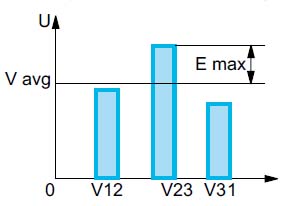
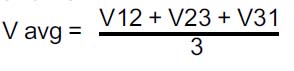
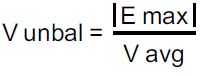
Voltage unbalance on the most unbalanced phase, displayed as a percentage of Vavg.
[Schneider Electric]Небаланс напряжений
Самое значительное отличие по модулю значения одного из линейных напряжений, выраженное в процентах от среднего напряжения Vavg.
[Перевод Интент]
Недопустимые, нерекомендуемые
Тематики
EN
DE
FR
Смотри также
несимметрия напряжений
Состояние системы энергоснабжения трехфазного переменного тока, в которой среднеквадратические значения основных составляющих междуфазных напряжений или углы сдвига фаз между основными составляющими междуфазных напряжений не равны между собой.
Примечания
1 Степень несимметрии обычно выражают отношением напряжений обратной и нулевой последовательностей к напряжению прямой последовательности.
2 В настоящем стандарте несимметрия напряжений рассматривается применительно только к трехфазным системам энергоснабжения.
[ ГОСТ Р 51317.4.30-2008 (МЭК 61000-4-30:2008)]EN
voltage unbalance
condition in a polyphase system in which the r.m.s. values of the line voltages (fundamental component), and/or the phase angles between consecutive line voltages, are not all equal
NOTE 1 The degree of the inequality is usually expressed as the ratios of the negative- and zero-sequence components to the positive-sequence component.
NOTE 2 In this standard, voltage unbalance is considered in relation to 3-phase systems.
[IEC 61000-4-30, ed. 2.0 (2008-10)]FR
déséquilibre de tension
dans un réseau d’énergie électrique polyphasé, état dans lequel les valeurs efficaces des tensions entre conducteurs (composante fondamentale), et/ou les différences de phase entre conducteurs successifs, ne sont pas toutes égales
NOTE 1 Le taux de déséquilibre s’exprime habituellement par le rapport de la composante inverse ou homopolaire à la composante directe.
NOTE 2 Dans la présente norme, le déséquilibre de tension est relatif aux réseaux triphasés.
[IEC 61000-4-30, ed. 2.0 (2008-10)]Тематики
EN
FR
3.34 несимметрия напряжений (voltage unbalance): Состояние системы энергоснабжения трехфазного переменного тока, в которой среднеквадратические значения основных составляющих междуфазных напряжений или углы сдвига фаз между основными составляющими междуфазных напряжений не равны между собой.
Примечания
1 Степень несимметрии обычно выражают отношением напряжений обратной и нулевой последовательностей к напряжению прямой последовательности.
2 В настоящем стандарте несимметрия напряжений рассматривается применительно только к трехфазным системам энергоснабжения.
3.35 установившееся отклонение напряжения: Разность между среднеквадратическим значением напряжения основной частоты в системе электроснабжения, определенным на установленном интервале времени, и номинальным значением напряжения.
3.36
Источник: ГОСТ Р 51317.4.30-2008: Электрическая энергия. Совместимость технических средств электромагнитная. Методы измерений показателей качества электрической энергии оригинал документа
3.2.11 небаланс напряжения (voltage unbalance); δU2,0: Соотношение составляющей отрицательной или нулевой последовательности и составляющей положительной последовательности при холостом ходе, выражаемое в процентах номинального напряжения.
Источник: ГОСТ Р 53986-2010: Электроагрегаты генераторные переменного тока с приводом от двигателя внутреннего сгорания. Часть 3. Генераторы переменного тока оригинал документа
Англо-русский словарь нормативно-технической терминологии > voltage unbalance
12 степень
жен.
1) degree, extent до известной степени, до некоторой степени ≈ to some degree, to some extent, to a certain extent в должной степени ≈ to the right degree, sufficiently в меньшей степени ≈ a lesser degree в значительной степени ≈ a great extent в известной степени ≈ fairly
2) грам. степени сравнения сравнительная степень
3) мат. power возводить во вторую степень ≈ to raise to the second power показатель степени ≈ exponent мат.
4) (ученое звание) (academic) degreeстепен|ь - ж.
1. (сравнительная величина) degree;
~ контрастности тех. contrast grade;
~ сжатия газа compression;
2. тк. ед. (мера, предел, отношение) degree;
extent;
до известной ~и, до некоторой ~и to a certain extent;
в той или иной ~и one way or another;
в значительной ~и to a considerable extent;
до какой ~и? to what exent?;
3. (ученое звание) degree;
~ доктора Doctor`s degree;
~ кандидата наук Master`s degree;
присуждать учёную ~ кому-л. confer a degree on smb. ;
4. (разряд, категория) class;
5. мат. power;
возводить что-л. в третью и т. д. ~ raise smth. to the third, etc. power;
~ родства relation;
в высшей ~и
1) (очень) extremely, most;
2) (совсем) utterly;
ни в малейшей ~и not in the least.13 near
I 1. [nɪə(r)]1) (nearby) vicinothe time is near when... — si avvicina il tempo in cui...
3) (nearly)4) near enoughthere are 20 yachts near enough — (approximately) ci sono circa 20 yacht
2.that's near enough — (not any closer) così vicino va bene; (acceptable as quantity) ce n'è abbastanza
1) (in space) vicino a [place, person, object]2) (in time)it's getting near Christmas — si sta avvicinando il o siamo quasi a Natale
3) (in degree) vicino ahe's no nearer (making) a decision — è sempre allo stesso punto, non ha ancora deciso
nobody comes anywhere near her — fig. nessuno può reggere il confronto con lei
4) near to (in space) vicino a [place, person, object]to be near to tears, to doing — (on point of) essere sul punto di piangere, sul punto di fare; (in degree)
II [nɪə(r)]to come nearest to — avvicinarsi il più possibile a [ ideal]
1) (close in distance, time) vicino, prossimo2) (in degree)he's the nearest thing to an accountant we've got — tra tutti è quello che se ne intende di più di ragioneria
it's the nearest thing — (to article, colour required) è la cosa più simile
3) (short)4) near- in composti quasiIII [nɪə(r)]verbo transitivo avvicinarsi a (anche fig.)to near completion — [ book] essere quasi terminato
to near retirement — essere vicino o prossimo alla pensione
* * *[niə] 1. adjective1) (not far away in place or time: The station is quite near; Christmas is getting near.) vicino2) (not far away in relationship: He is a near relation.) prossimo2. adverb1) (to or at a short distance from here or the place mentioned: He lives quite near.) vicino2) ((with to) close to: Don't sit too near to the window.) vicino3. preposition(at a very small distance from (in place, time etc): She lives near the church; It was near midnight when they arrived.) vicino4. verb(to come near (to): The roads became busier as they neared the town; as evening was nearing.) avvicinarsi- nearly- nearness
- nearby
- nearside
- near-sighted
- a near miss* * *I 1. [nɪə(r)]1) (nearby) vicinothe time is near when... — si avvicina il tempo in cui...
3) (nearly)4) near enoughthere are 20 yachts near enough — (approximately) ci sono circa 20 yacht
2.that's near enough — (not any closer) così vicino va bene; (acceptable as quantity) ce n'è abbastanza
1) (in space) vicino a [place, person, object]2) (in time)it's getting near Christmas — si sta avvicinando il o siamo quasi a Natale
3) (in degree) vicino ahe's no nearer (making) a decision — è sempre allo stesso punto, non ha ancora deciso
nobody comes anywhere near her — fig. nessuno può reggere il confronto con lei
4) near to (in space) vicino a [place, person, object]to be near to tears, to doing — (on point of) essere sul punto di piangere, sul punto di fare; (in degree)
II [nɪə(r)]to come nearest to — avvicinarsi il più possibile a [ ideal]
1) (close in distance, time) vicino, prossimo2) (in degree)he's the nearest thing to an accountant we've got — tra tutti è quello che se ne intende di più di ragioneria
it's the nearest thing — (to article, colour required) è la cosa più simile
3) (short)4) near- in composti quasiIII [nɪə(r)]verbo transitivo avvicinarsi a (anche fig.)to near completion — [ book] essere quasi terminato
to near retirement — essere vicino o prossimo alla pensione
14 imbalance in the voltages
небаланс напряжений
Отличие по модулю значения хотя бы одного из фазных или линейных напряжений многофазной системы электроснабжения от значений напряжений других фаз.
[ ГОСТ 23875-88]EN
voltage unbalance
phenomenon due to the differences between voltage deviations on the various phases, at a point of a polyphase system, resulting from differences between the phase currents or geometrical asymmetry in the line
[IEV number 604-01-29]
voltage unbalance (imbalance)
in a polyphase system, a condition in which the magnitudes of the phase voltages or the phase angles between consecutive phases are not all equal (fundamental component)
NOTE In three phase systems, the degree of inequality is usually expressed as the ratio of the negative and zero sequence components to the positive sequence component. In this technical report, voltage unbalance is considered in relation to three-phase systems and negative sequence only
[IEC 61000-3-13, ed. 1.0 (2008-02)]
voltage unbalance
condition in a polyphase system in which the r.m.s. values of the line voltages (fundamental component), and/or the phase angles between consecutive line voltages, are not all equal
NOTE 1 The degree of the inequality is usually expressed as the ratios of the negative- and zero-sequence components to the positive-sequence component.
NOTE 2 In this standard, voltage unbalance is considered in relation to 3-phase systems.
[IEC 61000-4-30, ed. 2.0 (2008-10)]FR
déséquilibre des tensions d'un réseau
phénomène résultant des différences de charge ou des dissymétries géométriques de lignes et qui provoque des différences entre les écarts de tension sur les diverses phases en un point d'un réseau polyphasé
[IEV number 604-01-29]
déséquilibre de tension
dans un réseau d’énergie électrique polyphasé, état dans lequel les valeurs efficaces des tensions entre conducteurs (composante fondamentale), et/ou les différences de phase entre conducteurs successifs, ne sont pas toutes égales
NOTE 1 Le taux de déséquilibre s’exprime habituellement par le rapport de la composante inverse ou homopolaire à la composante directe.
NOTE 2 Dans la présente norme, le déséquilibre de tension est relatif aux réseaux triphasés
[IEC 61000-4-30, ed. 2.0 (2008-10)]Параллельные тексты EN-RU
Voltage unbalance
Voltage unbalance on the most unbalanced phase, displayed as a percentage of Vavg.
[Schneider Electric]Небаланс напряжений
Самое значительное отличие по модулю значения одного из линейных напряжений, выраженное в процентах от среднего напряжения Vavg.
[Перевод Интент]
Недопустимые, нерекомендуемые
Тематики
EN
DE
FR
Смотри также
Англо-русский словарь нормативно-технической терминологии > imbalance in the voltages
15 unbalance voltage
небаланс напряжений
Отличие по модулю значения хотя бы одного из фазных или линейных напряжений многофазной системы электроснабжения от значений напряжений других фаз.
[ ГОСТ 23875-88]EN
voltage unbalance
phenomenon due to the differences between voltage deviations on the various phases, at a point of a polyphase system, resulting from differences between the phase currents or geometrical asymmetry in the line
[IEV number 604-01-29]
voltage unbalance (imbalance)
in a polyphase system, a condition in which the magnitudes of the phase voltages or the phase angles between consecutive phases are not all equal (fundamental component)
NOTE In three phase systems, the degree of inequality is usually expressed as the ratio of the negative and zero sequence components to the positive sequence component. In this technical report, voltage unbalance is considered in relation to three-phase systems and negative sequence only
[IEC 61000-3-13, ed. 1.0 (2008-02)]
voltage unbalance
condition in a polyphase system in which the r.m.s. values of the line voltages (fundamental component), and/or the phase angles between consecutive line voltages, are not all equal
NOTE 1 The degree of the inequality is usually expressed as the ratios of the negative- and zero-sequence components to the positive-sequence component.
NOTE 2 In this standard, voltage unbalance is considered in relation to 3-phase systems.
[IEC 61000-4-30, ed. 2.0 (2008-10)]FR
déséquilibre des tensions d'un réseau
phénomène résultant des différences de charge ou des dissymétries géométriques de lignes et qui provoque des différences entre les écarts de tension sur les diverses phases en un point d'un réseau polyphasé
[IEV number 604-01-29]
déséquilibre de tension
dans un réseau d’énergie électrique polyphasé, état dans lequel les valeurs efficaces des tensions entre conducteurs (composante fondamentale), et/ou les différences de phase entre conducteurs successifs, ne sont pas toutes égales
NOTE 1 Le taux de déséquilibre s’exprime habituellement par le rapport de la composante inverse ou homopolaire à la composante directe.
NOTE 2 Dans la présente norme, le déséquilibre de tension est relatif aux réseaux triphasés
[IEC 61000-4-30, ed. 2.0 (2008-10)]Параллельные тексты EN-RU
Voltage unbalance
Voltage unbalance on the most unbalanced phase, displayed as a percentage of Vavg.
[Schneider Electric]Небаланс напряжений
Самое значительное отличие по модулю значения одного из линейных напряжений, выраженное в процентах от среднего напряжения Vavg.
[Перевод Интент]
Недопустимые, нерекомендуемые
Тематики
EN
DE
FR
Смотри также
Англо-русский словарь нормативно-технической терминологии > unbalance voltage
16 voltage imbalance
небаланс напряжений
Отличие по модулю значения хотя бы одного из фазных или линейных напряжений многофазной системы электроснабжения от значений напряжений других фаз.
[ ГОСТ 23875-88]EN
voltage unbalance
phenomenon due to the differences between voltage deviations on the various phases, at a point of a polyphase system, resulting from differences between the phase currents or geometrical asymmetry in the line
[IEV number 604-01-29]
voltage unbalance (imbalance)
in a polyphase system, a condition in which the magnitudes of the phase voltages or the phase angles between consecutive phases are not all equal (fundamental component)
NOTE In three phase systems, the degree of inequality is usually expressed as the ratio of the negative and zero sequence components to the positive sequence component. In this technical report, voltage unbalance is considered in relation to three-phase systems and negative sequence only
[IEC 61000-3-13, ed. 1.0 (2008-02)]
voltage unbalance
condition in a polyphase system in which the r.m.s. values of the line voltages (fundamental component), and/or the phase angles between consecutive line voltages, are not all equal
NOTE 1 The degree of the inequality is usually expressed as the ratios of the negative- and zero-sequence components to the positive-sequence component.
NOTE 2 In this standard, voltage unbalance is considered in relation to 3-phase systems.
[IEC 61000-4-30, ed. 2.0 (2008-10)]FR
déséquilibre des tensions d'un réseau
phénomène résultant des différences de charge ou des dissymétries géométriques de lignes et qui provoque des différences entre les écarts de tension sur les diverses phases en un point d'un réseau polyphasé
[IEV number 604-01-29]
déséquilibre de tension
dans un réseau d’énergie électrique polyphasé, état dans lequel les valeurs efficaces des tensions entre conducteurs (composante fondamentale), et/ou les différences de phase entre conducteurs successifs, ne sont pas toutes égales
NOTE 1 Le taux de déséquilibre s’exprime habituellement par le rapport de la composante inverse ou homopolaire à la composante directe.
NOTE 2 Dans la présente norme, le déséquilibre de tension est relatif aux réseaux triphasés
[IEC 61000-4-30, ed. 2.0 (2008-10)]Параллельные тексты EN-RU
Voltage unbalance
Voltage unbalance on the most unbalanced phase, displayed as a percentage of Vavg.
[Schneider Electric]Небаланс напряжений
Самое значительное отличие по модулю значения одного из линейных напряжений, выраженное в процентах от среднего напряжения Vavg.
[Перевод Интент]
Недопустимые, нерекомендуемые
Тематики
EN
DE
FR
Смотри также
неуравновешенность напряжений
асимметрия напряжений (многофазной системы)
—
[Я.Н.Лугинский, М.С.Фези-Жилинская, Ю.С.Кабиров. Англо-русский словарь по электротехнике и электроэнергетике, Москва, 1999]Тематики
- электротехника, основные понятия
Синонимы
EN
Англо-русский словарь нормативно-технической терминологии > voltage imbalance
17 recursively
1) рекурсно
2) рекурсивно
3) рекуррентно ∙ completely recursively enumerable class ≈ вполне рекурсивно перечислимый класс general recursively inequal numbers ≈ общерекурсивно неравные числа general recursively irrational number ≈ общерекурсивно иррациональное число general recursively true ≈ общерекурсивно истинный general recursively true formula ≈ общерекурсивно истинная формула primitive recursively true ≈ примитивно-рекурсивно истинный recursively approximable set ≈ рекурсивно аппроксимируемое множество recursively axiomatizable theor ≈ рекурсивно аксиоматизируемая теория recursively axiomatized theor ≈ рекурсивно аксиоматизированная теория recursively bounded quantifier ≈ рекурсивно ограниченный квантор recursively calculable function ≈ рекурсивно вычислимая функция recursively complex number ≈ рекурсивно комплексное число recursively continuous function ≈ рекурсивно непрерывная функция recursively convergent function ≈ рекурсивно сходящаяся функция recursively convergent sequence ≈ рекурсивно сходящаяся последовательность recursively creative set ≈ рекурсивно креативное множество recursively defined function ≈ рекуррентно определенная функция recursively defined sequence ≈ рекурсивно определенная последовательность recursively differentiable function ≈ рекурсивно дифференцируемая функция recursively divergent function ≈ рекурсивно расходящаяся функция recursively divergent sequence ≈ рекурсивно расходящаяся последовательность recursively enumerable cylinder ≈ рекурсивно перечислимый цилиндр recursively enumerable degree ≈ рекурсивно перечислимая степень recursively enumerable index ≈ рекурсивно перечислимый индекс recursively enumerable ordinal ≈ рекурсивно перечислимое порядковое число recursively enumerable predicate ≈ рекурсивно перечислимый предикат recursively enumerable problem ≈ рекурсивно перечислимая проблема recursively enumerable relation ≈ рекурсивно перечислимое отношение recursively enumerable sequence ≈ рекурсивно перечислимая последовательность recursively enumerable set ≈ рекурсивное перечислимое множество recursively enumerable structure ≈ рекурсивно перечислимая структура recursively enumerable subclass ≈ рекурсивно перечислимый подкласс recursively enumerable subset ≈ рекурсивно перечислимое подмножество recursively enumerable theor ≈ рекурсивно перечислимая теория recursively equivalent sets ≈ рекурсивно эквивалентные множества recursively extensible function ≈ рекурсивно продолжаемая функция recursively incompletable theor ≈ рекурсивно непополнимая теория recursively indecomposable set ≈ рекурсивно неразложимое множество recursively inseparable sets ≈ рекурсивно неотделимые множества recursively invariant concept ≈ рекурсивно инвариантное понятие recursively invariant relation ≈ рекурсивно инвариантное отношение recursively isomorphic set ≈ рекурсивно изоморфное множество recursively presentable structure ≈ рекурсивно представимая структура recursively presented group ≈ рекурсивно определенная группа recursively productive set ≈ рекурсивно продуктивное множество recursively real number ≈ рекурсивно вещественное число recursively related system of notation ≈ рекурсивная по упорядочению система обозначений recursively representable operation ≈ рекурсивно представимая операция recursively representable relation ≈ рекурсивно представимое отношение recursively separable sets ≈ рекурсивно отделимые множества recursively solvable problem ≈ рекурсивно разрешимая проблема recursively undecidable theor ≈ рекурсивно неразрешимая теория recursively unequal numbers ≈ рекурсивно неравные числа - recursively axiomatized - recursively calculable - recursively closed - recursively computable - recursively conditional - recursively continuous - recursively convergent - recursively differentiable - recursively divergent - recursively enumerable - recursively equivalent - recursively expressible - recursively extensible - recursively inseparable - recursively isomorphic - recursively isotonic - recursively presentable - recursively projective - recursively realizable - recursively representable - recursively soluble - recursively true - recursively unsolvable РекурсивноБольшой англо-русский и русско-английский словарь > recursively
18 near
niə
1. adjective1) (not far away in place or time: The station is quite near; Christmas is getting near.) cerca2) (not far away in relationship: He is a near relation.) próximo
2. adverb1) (to or at a short distance from here or the place mentioned: He lives quite near.) cerca2) ((with to) close to: Don't sit too near to the window.) cerca
3. preposition(at a very small distance from (in place, time etc): She lives near the church; It was near midnight when they arrived.) cerca de
4. verb(to come near (to): The roads became busier as they neared the town; as evening was nearing.) acercarse a- nearly- nearness
- nearby
- nearside
- near-sighted
- a near miss
near adj adv cercais the station near here? ¿está cerca la estación?tr[nɪəSMALLr/SMALL]1 cercano,-a■ where is the nearest bank? ¿dónde está el banco más cercano?2 (relations) cercano,-a3 (time) próximo,-a4 (similar) parecido,-a■ this is the nearest we have, I'm afraid lo siento, pero esto es lo más parecido que tenemos1 cerca1 cerca de1 acercarse a■ we are nearing the day when... nos acercamos al día en que...\SMALLIDIOMATIC EXPRESSION/SMALLto come near acercarseto come near to doing something estar en un tris de hacer algoto draw near acercarsenear miss (shot) tiro que no da en el blanco por poco 2 (situation) situación que no se produce por poco■ the lorry almost hit us, it was a near miss por poco nos da el camión, nos escapamos por los pelosnear ['nɪr] vt1) : acercarse athe ship is nearing port: el barco se está acercando al puerto2) : estar a punto deshe is nearing graduation: está a punto de graduarsenear adv1) close: cercamy family lives quite near: mi familia vive muy cerca2) nearly: casiI came near to finishing: casi terminénear adj1) close: cercano, próximo2) similar: parecido, semejantenear prep: cerca deadj.• afín adj.• allegado, -a adj.• aproximado, -a adj.• cerca adj.• cercano, -a adj.• estrecho, -a adj.• inmediato, -a adj.• propincuo, -a adj.• próximo (Cercano) adj.• vecino, -a adj.• íntimo, -a adj.adv.• cerca adv.prep.• cerca de prep.• hacia prep.• sobre prep.v.• acercarse v.
I nɪr, nɪə(r)adjective -er, -est1)a) ( in position) cercano, próximob) ( in time) cercano, próximoc) ( in approximation) parecidothat's the nearest thing to an apology you can expect from him — eso es lo más parecido a una disculpa que se puede esperar de él
d) < relative> cercano2) ( virtual) (before n)3) (BrE Auto, Equ) izquierdo
II
adverb -er, -est1)a) ( in position) cercab) ( in time)c) ( in approximation)the total will be nearer to $1,000 than $500 — el total va a estar más cerca de 1.000 que de 500 dólares
d) ( on the verge of)near to something/-ing: she was near to tears estaba al borde de las lágrimas or a punto de echarse a llorar; I came very near to hitting him — estuve a punto de pegarle, por poco le pego
2) ( nearly) casiI'm nowhere near finished — me falta mucho or (colloq) un montón para terminar
that's nowhere near enough — (colloq) con eso no alcanza, ni mucho menos
it'll cost $1,000, near enough — (colloq) costará 1.000 dólares, o por ahí (fam)
III
preposition -er, -esta) ( in position) cerca deb) ( in time)c) ( in approximation)damage was estimated at somewhere near $2,000 — los daños se calcularon en cerca de 2.000 dólares
d) ( on the verge of)
IV
transitive verb acercarse* a[nɪǝ(r)]1. ADV1) (in place) cercadon't come any nearer! — ¡no te acerques más!
•
so near and yet so far, the shore was so near and yet so far — la orilla estaba al alcance de la mano pero llegar a ella era imposiblevictory was so near and yet so far — la victoria parecía estar asegurada pero ese último esfuerzo para obtenerla les resultó imposible
2) (in time)•
the agreement brings peace a little nearer — este acuerdo nos acerca un poco más a la paz•
winter is drawing near — el invierno se acerca•
the nearer it gets to the election the more they look like losing — a medida que se acercan las elecciones mayor parece la posibilidad de que pierdan•
to be near at hand — [object] estar al alcance de la mano; [event, season] estar a la vuelta de la esquina3) (in level, degree)•
the nearest I ever came to feeling that was when... — la única vez que llegué a sentir algo parecido fue cuando...•
you as near as dammit killed me * — no me mataste, pero por un pelo *•
you won't get any nearer than that to what you want — no vas a encontrar otra cosa que se aproxime más a lo que buscas"have you finished it yet?" - "nowhere near" — -¿has terminado ya? -qué va, me falta muchísimo
4) (=almost) casi•
I came near to telling her everything — llegué casi a decírselo todo•
near on 3,000 people — casi 3.000 personas•
it's in near perfect condition — está casi en perfectas condiciones•
I could hardly see it in the near total darkness — apenas lo veía en la oscuridad que era casi total2. PREP(also: near to)1) (of place) cerca deis there a bank near here? — ¿hay algún banco por aquí cerca?
•
we don't live anywhere near Lincoln — vivimos bastante or muy lejos de Lincoln•
if you come near me I'll kill you — como te me acerques, te mato•
the passage is near the end of the book — el trozo viene hacia el final del libro•
don't go near the edge — no te acerques al borde•
we were nowhere near the station — estábamos bastante or muy lejos de la estación2) (in time)3) (=almost)•
she was near death — estaba al borde de la muerte, tocaba a su fin liter3. ADJ1) (in place) cercanomy house is near enough to walk — mi casa está muy cerca, se puede ir andando
where's the nearest service station? — ¿dónde está la gasolinera más cercana?
2) (in time) próximo•
the time is near when... — falta poco cuando...3) (in level, degree)that's the nearest thing to a compliment you'll get from him — iro eso es lo más parecido a un elogio que vas a conseguir de él
a near thing —
she won, but it was a near thing — ganó, pero por los pelos
4) [relative] cercano4. VT1) (in space) acercarse a2) (in time)he is nearing 50 — frisa en los 50, tiene casi 50 años
3) (in level, degree)5.VI acercarse6.CPDnear miss N — [of planes] casi colisión f ; (when aiming) casi acierto m ; (in competition) (=near-victory) casi victoria f
he had a near miss — (Aer) no se estrelló por poco; (Aut) no chocó por poco
it was a near miss — (target) no dio en el blanco por poco
near money N — (Comm) activos mpl realizables
* * *
I [nɪr, nɪə(r)]adjective -er, -est1)a) ( in position) cercano, próximob) ( in time) cercano, próximoc) ( in approximation) parecidothat's the nearest thing to an apology you can expect from him — eso es lo más parecido a una disculpa que se puede esperar de él
d) < relative> cercano2) ( virtual) (before n)3) (BrE Auto, Equ) izquierdo
II
adverb -er, -est1)a) ( in position) cercab) ( in time)c) ( in approximation)the total will be nearer to $1,000 than $500 — el total va a estar más cerca de 1.000 que de 500 dólares
d) ( on the verge of)near to something/-ing: she was near to tears estaba al borde de las lágrimas or a punto de echarse a llorar; I came very near to hitting him — estuve a punto de pegarle, por poco le pego
2) ( nearly) casiI'm nowhere near finished — me falta mucho or (colloq) un montón para terminar
that's nowhere near enough — (colloq) con eso no alcanza, ni mucho menos
it'll cost $1,000, near enough — (colloq) costará 1.000 dólares, o por ahí (fam)
III
preposition -er, -esta) ( in position) cerca deb) ( in time)c) ( in approximation)damage was estimated at somewhere near $2,000 — los daños se calcularon en cerca de 2.000 dólares
d) ( on the verge of)
IV
transitive verb acercarse* a19 to
1. tə,tu preposition1) (towards; in the direction of: I cycled to the station; The book fell to the floor; I went to the concert/lecture/play.) a, hacia2) (as far as: His story is a lie from beginning to end.) a, hasta3) (until: Did you stay to the end of the concert?) hasta4) (sometimes used to introduce the indirect object of a verb: He sent it to us; You're the only person I can talk to.) con, a5) (used in expressing various relations: Listen to me!; Did you reply to his letter?; Where's the key to this door?; He sang to (the accompaniment of) his guitar.) a, para6) (into a particular state or condition: She tore the letter to pieces.) en7) (used in expressing comparison or proportion: He's junior to me; Your skill is superior to mine; We won the match by 5 goals to 2.) a8) (showing the purpose or result of an action etc: He came quickly to my assistance; To my horror, he took a gun out of his pocket.) en; para9) (tə used before an infinitive eg after various verbs and adjectives, or in other constructions: I want to go!; He asked me to come; He worked hard to (= in order to) earn a lot of money; These buildings were designed to (= so as to) resist earthquakes; She opened her eyes to find him standing beside her; I arrived too late to see him.) para10) (used instead of a complete infinitive: He asked her to stay but she didn't want to.) (hacerlo)
2. tu: adverb1) (into a closed or almost closed position: He pulled/pushed the door to.) hasta cerrar2) (used in phrasal verbs and compounds: He came to (= regained consciousness).) a•to prep1. a2. a / hastashe works from nine to five trabaja de nueve a cinco / trabaja desde las nueve hasta las cinco3. menos4. paratotr[tʊ, ʊnstressed tə]1 (with place) a■ did you go to the bank? ¿fuiste al banco?■ A is to the north/south/east/west of B A está al norte/sur/este/oeste de B2 (towards) hacia3 (as far as, until) a, hasta■ I like all music, from Abba to ZZTop me gusta toda la música, desde Abba hasta ZZTop4 (of time) menos6 (for) de■ what's the answer to question 4? ¿cuál es la respuesta a la pregunta número 4?7 (attitude, behaviour) con, para con8 (in honour of) a9 (touching) a, contra10 (accompanied by) acompañado,-a de11 (causing something) para■ to my surprise, it was empty para mi sorpresa, estaba vacío12 (as seen by) por lo que respecta■ to a foreigner, it must seem awful para un extranjero, debe parecer terrible■ to some people he was a hero, to others a traitor para algunos era un héroe, para otros era un traidor14 (ratio) a15 (per, equivalent) a, en■ how much does your car do to the gallon? ≈ ¿cuánto gasta tu coche a los cien kilómetros?16 (according to) según■ is it to your taste? ¿es de su agrado?17 (result) a18 (in order to) para, a fin de■ would you like to dance? --I'd love to ¿te gustaría bailar? --me encantaría■ she didn't want to go, but she had to no quería ir, pero no le quedaba más remedio1 (of door) ajustada\SMALLIDIOMATIC EXPRESSION/SMALLto and fro vaivén, ir y venir Table 1SMALLNOTA/SMALL Cuando se usa con la raíz del verbo para formar el infinitivo no se traduce/Table 1 ■ I want to help you quiero ayudarteto ['tu:] adv1) : a un estado conscienteto come to: volver en sí2)to and fro : de aquí para allá, de un lado para otroto prepto go to the doctor: ir al médicoI'm going to John's: voy a la casa de John2) toward: a, haciatwo miles to the south: dos millas hacia el sur3) on: en, sobreapply salve to the wound: póngale ungüento a la herida4) up to: hasta, ato a degree: hasta cierto gradofrom head to toe: de pies a cabezait's quarter to seven: son las siete menos cuarto6) until: a, hastafrom May to December: de mayo a diciembrethe key to the lock: la llave del candadodancing to the rhythm: bailando al compásit's similar to mine: es parecido al míothey won 4 to 2: ganaron 4 a 2made to order: hecho a la ordento my knowledge: a mi sabertwenty to the box: veinte por cajato understand: entenderto go away: irse
I tuː, weak form tə1)a) ( indicating destination) awe went to John's — fuimos a casa de John, fuimos a lo de John (RPl), fuimos donde John (esp AmL)
you can wear it to a party/the wedding — puedes ponértelo para una fiesta/la boda
b) ( indicating direction) haciac) ( indicating position) ato the left/right of something — a la izquierda/derecha de algo
2) (against, onto)3)a) ( as far as) hastab) ( until) hastac) ( indicating range)there will be 30 to 35 guests — habrá entre 30 y 35 invitados; see also from 4)
4)a) ( showing indirect object)who did you send/give it to? — ¿a quién se lo mandaste/diste?
what did you say to him/them? — ¿qué le/les dijiste?
I'll hand you over to Jane — te paso or (Esp tb) te pongo con Jane
I was singing/talking to myself — estaba cantando/hablando solo
to me, he will always be a hero — para mí, siempre será un héroe
he was very kind/rude to me — fue muy amable/grosero conmigo
b) (in toasts, dedications)to Paul with love from Jane — para Paul, con cariño de Jane
5) (indicating proportion, relation)how many ounces are there to the pound? — ¿cuántas onzas hay en una libra?
it does 30 miles to the gallon — da or rinde 30 millas por galón, consume 6.75 litros a los or por cada cien kilómetros
there's a 10 to 1 chance of... — hay una probabilidad de uno en 10 de...
that's nothing to what followed — eso no es nada comparado or en comparación con lo que vino después
6) ( concerning)what do you say to that? — ¿qué dices a eso?, ¿qué te parece (eso)?
there's nothing to it — es muy simple or sencillo
7)a) ( in accordance with)b) ( producing)to my horror/delight... — para mi horror/alegría...
c) ( indicating purpose)8) ( indicating belonging) dethe solution to the problem — la solución al or del problema
it has a nice ring/sound to it — suena bien
9) ( telling time) (BrE)ten to three — las tres menos diez, diez para las tres (AmL exc RPl)
10) ( accompanied by)they sang it to the tune of `Clementine' — lo cantaron con la melodía de `Clementine'
II tə1)a)to sing/fear/leave — cantar/temer/partir
b) ( in order to) parac) ( indicating result)he awoke to find her gone — cuando despertó, ella ya se había ido
I walked 5 miles only to be told they weren't home — caminé 5 millas para que me dijeran que no estaban en casa
d) ( without vb)2) (after adj or n)it's easy/difficult to do — es fácil/difícil de hacer
III tuː [tʊ, tuː, tǝ]1. PREPOSITIONWhen to is the second element in a phrasal verb, eg set to, heave to, look up the phrasal verb. When to is part of a set combination, eg nice to, to my mind, to all appearances, appeal to, look up the other word.1) (destination) aNote: a + el = al
it's 90 kilometres to Lima — de aquí a Lima hay 90 kilómetros, hay 90 kilómetros a Lima
to go to Paris/Spain — ir a París/España
to go to school/university — ir al colegio/a la Universidad
I liked the exhibition, I went to it twice — me gustó la exposición, fui a verla dos veces
we're going to John's/my parents' for Christmas — vamos a casa de John/mis padres por Navidad
•
have you ever been to India? — ¿has estado alguna vez en la India?•
flights to Heathrow — vuelos a or con destino a Heathrowchurch 1., 2)•
the road to Edinburgh — la carretera de Edimburgo2) (=towards) haciamove it to the left/right — muévelo hacia la izquierda/derecha
3) (=as far as) hastafrom here to London — de aquí a or hasta Londres
4) (=up to) hastato some extent — hasta cierto punto, en cierta medida
•
to this day I still don't know what he meant — aún hoy no sé lo que quiso decir•
from Monday to Friday — de lunes a viernesfrom morning to night — de la mañana a la noche, desde la mañana hasta la noche
decimal 1.•
funds to the value of... — fondos por valor de...5) (=located at) a6) (=against) contrait's a quarter to three — son las tres menos cuarto, es or (LAm) falta un cuarto para las tres
the man I sold it to or frm to whom I sold it — el hombre a quien se lo vendí
it belongs to me — me pertenece (a mí), es mío
what is that to me? — ¿y a mí qué me importa eso?
"that's strange," I said to myself — -es raro -me dije para mis adentros
9) (in dedications, greetings)greetings to all our friends! — ¡saludos a todos los amigos!
welcome to you all! — ¡bienvenidos todos!
"to P.R. Lilly" — (in book) "para P.R. Lilly"
here's to you! — ¡va por ti!, ¡por ti!
a monument to the fallen — un monumento a los caídos, un monumento en honor a los caídos
10) (in ratios, proportions) porthe odds against it happening are a million to one — las probabilidades de que eso ocurra son una entre un millón
three to the fourth, three to the power of four — (Math) tres a la cuarta potencia
11) (in comparisons) a12) (=about, concerning)what do you say to that? — ¿qué te parece (eso)?
what would you say to a beer? — ¿te parece que tomemos una cerveza?
"to repairing pipes:..." — (on bill) "reparación de las cañerías:..."
13) (=according to) segúnto my way of thinking — a mi modo de ver, según mi modo de pensar
14) (=to the accompaniment of)it is sung to the tune of "Tipperary" — se canta con la melodía de "Tipperary"
15) (=of, for) de16) (with gerund/noun)•
to look forward to doing sth — tener muchas ganas de hacer algo•
to prefer painting to drawing — preferir pintar a dibujar•
to be used to (doing) sth — estar acostumbrado a (hacer) algo•
to this end — a or con este fin•
to my enormous shame I did nothing — para gran vergüenza mía, no hice nada•
to my great surprise — con gran sorpresa por mi parte, para gran sorpresa mía2. INFINITIVE PARTICLE1) (infinitive)a)A preposition may be required with the Spanish infinitive, depending on what precedes it: look up the verb.•
she refused to listen — se negó a escuchar•
to start to cry — empezar or ponerse a llorar•
to try to do sth — tratar de hacer algo, intentar hacer algo•
to want to do sth — querer hacer algo•
I'd advise you to think this over — te aconsejaría que te pensaras bien esto•
he'd like me to give up work — le gustaría que dejase de trabajar•
we'd prefer him to go to university — preferiríamos que fuese a la universidad•
I want you to do it — quiero que lo hagasc)there was no one for me to ask, there wasn't anyone for me to ask — no había nadie a quien yo pudiese preguntar
he's not the sort or type to do that — no es de los que hacen eso
•
that book is still to be written — ese libro está todavía por escribir•
now is the time to do it — ahora es el momento de hacerlo•
and who is he to criticize? — ¿y quién es él para criticar?3) (purpose, result) paraThe particle to is not translated when it stands for the infinitive:it disappeared, never to be seen again — desapareció para siempre
we didn't want to sell it but we had to — no queríamos venderlo pero tuvimos que hacerlo or no hubo más remedio
"would you like to come to dinner?" - "I'd love to!" — -¿te gustaría venir a cenar? -¡me encantaría!
For combinations like difficult/easy/foolish/ ready/ slow to etc, look up the adjective.you may not want to do it but you ought to for the sake of your education — tal vez no quieres hacerlo pero deberías en aras de tu educación
the first/last to go — el primero/último en irse
See:EASY, DIFFICULT, IMPOSSIBLE in easyand then to be let down like that! — ¡y para que luego te decepcionen así!
and to think he didn't mean a word of it! — ¡y pensar que nada de lo que dijo era de verdad!
7)to see him now one would never think that... — al verlo or viéndolo ahora nadie creería que...
3.ADVERBto pull the door to — tirar de la puerta para cerrarla, cerrar la puerta tirando
to push the door to — empujar la puerta para cerrarla, cerrar la puerta empujando
* * *
I [tuː], weak form [tə]1)a) ( indicating destination) awe went to John's — fuimos a casa de John, fuimos a lo de John (RPl), fuimos donde John (esp AmL)
you can wear it to a party/the wedding — puedes ponértelo para una fiesta/la boda
b) ( indicating direction) haciac) ( indicating position) ato the left/right of something — a la izquierda/derecha de algo
2) (against, onto)3)a) ( as far as) hastab) ( until) hastac) ( indicating range)there will be 30 to 35 guests — habrá entre 30 y 35 invitados; see also from 4)
4)a) ( showing indirect object)who did you send/give it to? — ¿a quién se lo mandaste/diste?
what did you say to him/them? — ¿qué le/les dijiste?
I'll hand you over to Jane — te paso or (Esp tb) te pongo con Jane
I was singing/talking to myself — estaba cantando/hablando solo
to me, he will always be a hero — para mí, siempre será un héroe
he was very kind/rude to me — fue muy amable/grosero conmigo
b) (in toasts, dedications)to Paul with love from Jane — para Paul, con cariño de Jane
5) (indicating proportion, relation)how many ounces are there to the pound? — ¿cuántas onzas hay en una libra?
it does 30 miles to the gallon — da or rinde 30 millas por galón, consume 6.75 litros a los or por cada cien kilómetros
there's a 10 to 1 chance of... — hay una probabilidad de uno en 10 de...
that's nothing to what followed — eso no es nada comparado or en comparación con lo que vino después
6) ( concerning)what do you say to that? — ¿qué dices a eso?, ¿qué te parece (eso)?
there's nothing to it — es muy simple or sencillo
7)a) ( in accordance with)b) ( producing)to my horror/delight... — para mi horror/alegría...
c) ( indicating purpose)8) ( indicating belonging) dethe solution to the problem — la solución al or del problema
it has a nice ring/sound to it — suena bien
9) ( telling time) (BrE)ten to three — las tres menos diez, diez para las tres (AmL exc RPl)
10) ( accompanied by)they sang it to the tune of `Clementine' — lo cantaron con la melodía de `Clementine'
II [tə]1)a)to sing/fear/leave — cantar/temer/partir
b) ( in order to) parac) ( indicating result)he awoke to find her gone — cuando despertó, ella ya se había ido
I walked 5 miles only to be told they weren't home — caminé 5 millas para que me dijeran que no estaban en casa
d) ( without vb)2) (after adj or n)it's easy/difficult to do — es fácil/difícil de hacer
III [tuː]20 Philosophy
And what I believe to be more important here is that I find in myself an infinity of ideas of certain things which cannot be assumed to be pure nothingness, even though they may have perhaps no existence outside of my thought. These things are not figments of my imagination, even though it is within my power to think of them or not to think of them; on the contrary, they have their own true and immutable natures. Thus, for example, when I imagine a triangle, even though there may perhaps be no such figure anywhere in the world outside of my thought, nor ever have been, nevertheless the figure cannot help having a certain determinate nature... or essence, which is immutable and eternal, which I have not invented and which does not in any way depend upon my mind. (Descartes, 1951, p. 61)Let us console ourselves for not knowing the possible connections between a spider and the rings of Saturn, and continue to examine what is within our reach. (Voltaire, 1961, p. 144)As modern physics started with the Newtonian revolution, so modern philosophy starts with what one might call the Cartesian Catastrophe. The catastrophe consisted in the splitting up of the world into the realms of matter and mind, and the identification of "mind" with conscious thinking. The result of this identification was the shallow rationalism of l'esprit Cartesien, and an impoverishment of psychology which it took three centuries to remedy even in part. (Koestler, 1964, p. 148)It has been made of late a reproach against natural philosophy that it has struck out on a path of its own, and has separated itself more and more widely from the other sciences which are united by common philological and historical studies. The opposition has, in fact, been long apparent, and seems to me to have grown up mainly under the influence of the Hegelian philosophy, or, at any rate, to have been brought out into more distinct relief by that philosophy.... The sole object of Kant's "Critical Philosophy" was to test the sources and the authority of our knowledge, and to fix a definite scope and standard for the researches of philosophy, as compared with other sciences.... [But Hegel's] "Philosophy of Identity" was bolder. It started with the hypothesis that not only spiritual phenomena, but even the actual world-nature, that is, and man-were the result of an act of thought on the part of a creative mind, similar, it was supposed, in kind to the human mind.... The philosophers accused the scientific men of narrowness; the scientific men retorted that the philosophers were crazy. And so it came about that men of science began to lay some stress on the banishment of all philosophic influences from their work; while some of them, including men of the greatest acuteness, went so far as to condemn philosophy altogether, not merely as useless, but as mischievous dreaming. Thus, it must be confessed, not only were the illegitimate pretensions of the Hegelian system to subordinate to itself all other studies rejected, but no regard was paid to the rightful claims of philosophy, that is, the criticism of the sources of cognition, and the definition of the functions of the intellect. (Helmholz, quoted in Dampier, 1966, pp. 291-292)Philosophy remains true to its classical tradition by renouncing it. (Habermas, 1972, p. 317)I have not attempted... to put forward any grand view of the nature of philosophy; nor do I have any such grand view to put forth if I would. It will be obvious that I do not agree with those who see philosophy as the history of "howlers" and progress in philosophy as the debunking of howlers. It will also be obvious that I do not agree with those who see philosophy as the enterprise of putting forward a priori truths about the world.... I see philosophy as a field which has certain central questions, for example, the relation between thought and reality.... It seems obvious that in dealing with these questions philosophers have formulated rival research programs, that they have put forward general hypotheses, and that philosophers within each major research program have modified their hypotheses by trial and error, even if they sometimes refuse to admit that that is what they are doing. To that extent philosophy is a "science." To argue about whether philosophy is a science in any more serious sense seems to me to be hardly a useful occupation.... It does not seem to me important to decide whether science is philosophy or philosophy is science as long as one has a conception of both that makes both essential to a responsible view of the world and of man's place in it. (Putnam, 1975, p. xvii)What can philosophy contribute to solving the problem of the relation [of] mind to body? Twenty years ago, many English-speaking philosophers would have answered: "Nothing beyond an analysis of the various mental concepts." If we seek knowledge of things, they thought, it is to science that we must turn. Philosophy can only cast light upon our concepts of those things.This retreat from things to concepts was not undertaken lightly. Ever since the seventeenth century, the great intellectual fact of our culture has been the incredible expansion of knowledge both in the natural and in the rational sciences (mathematics, logic).The success of science created a crisis in philosophy. What was there for philosophy to do? Hume had already perceived the problem in some degree, and so surely did Kant, but it was not until the twentieth century, with the Vienna Circle and with Wittgenstein, that the difficulty began to weigh heavily. Wittgenstein took the view that philosophy could do no more than strive to undo the intellectual knots it itself had tied, so achieving intellectual release, and even a certain illumination, but no knowledge. A little later, and more optimistically, Ryle saw a positive, if reduced role, for philosophy in mapping the "logical geography" of our concepts: how they stood to each other and how they were to be analyzed....Since that time, however, philosophers in the "analytic" tradition have swung back from Wittgensteinian and even Rylean pessimism to a more traditional conception of the proper role and tasks of philosophy. Many analytic philosophers now would accept the view that the central task of philosophy is to give an account, or at least play a part in giving an account, of the most general nature of things and of man. (Armstrong, 1990, pp. 37-38)8) Philosophy's Evolving Engagement with Artificial Intelligence and Cognitive ScienceIn the beginning, the nature of philosophy's engagement with artificial intelligence and cognitive science was clear enough. The new sciences of the mind were to provide the long-awaited vindication of the most potent dreams of naturalism and materialism. Mind would at last be located firmly within the natural order. We would see in detail how the most perplexing features of the mental realm could be supported by the operations of solely physical laws upon solely physical stuff. Mental causation (the power of, e.g., a belief to cause an action) would emerge as just another species of physical causation. Reasoning would be understood as a kind of automated theorem proving. And the key to both was to be the depiction of the brain as the implementation of multiple higher level programs whose task was to manipulate and transform symbols or representations: inner items with one foot in the physical (they were realized as brain states) and one in the mental (they were bearers of contents, and their physical gymnastics were cleverly designed to respect semantic relationships such as truth preservation). (A. Clark, 1996, p. 1)Socrates of Athens famously declared that "the unexamined life is not worth living," and his motto aptly explains the impulse to philosophize. Taking nothing for granted, philosophy probes and questions the fundamental presuppositions of every area of human inquiry.... [P]art of the job of the philosopher is to keep at a certain critical distance from current doctrines, whether in the sciences or the arts, and to examine instead how the various elements in our world-view clash, or fit together. Some philosophers have tried to incorporate the results of these inquiries into a grand synoptic view of the nature of reality and our human relationship to it. Others have mistrusted system-building, and seen their primary role as one of clarifications, or the removal of obstacles along the road to truth. But all have shared the Socratic vision of using the human intellect to challenge comfortable preconceptions, insisting that every aspect of human theory and practice be subjected to continuing critical scrutiny....Philosophy is, of course, part of a continuing tradition, and there is much to be gained from seeing how that tradition originated and developed. But the principal object of studying the materials in this book is not to pay homage to past genius, but to enrich one's understanding of central problems that are as pressing today as they have always been-problems about knowledge, truth and reality, the nature of the mind, the basis of right action, and the best way to live. These questions help to mark out the territory of philosophy as an academic discipline, but in a wider sense they define the human predicament itself; they will surely continue to be with us for as long as humanity endures. (Cottingham, 1996, pp. xxi-xxii)10) The Distinction between Dionysian Man and Apollonian Man, between Art and Creativity and Reason and Self- ControlIn his study of ancient Greek culture, The Birth of Tragedy, Nietzsche drew what would become a famous distinction, between the Dionysian spirit, the untamed spirit of art and creativity, and the Apollonian, that of reason and self-control. The story of Greek civilization, and all civilizations, Nietzsche implied, was the gradual victory of Apollonian man, with his desire for control over nature and himself, over Dionysian man, who survives only in myth, poetry, music, and drama. Socrates and Plato had attacked the illusions of art as unreal, and had overturned the delicate cultural balance by valuing only man's critical, rational, and controlling consciousness while denigrating his vital life instincts as irrational and base. The result of this division is "Alexandrian man," the civilized and accomplished Greek citizen of the later ancient world, who is "equipped with the greatest forces of knowledge" but in whom the wellsprings of creativity have dried up. (Herman, 1997, pp. 95-96)Historical dictionary of quotations in cognitive science > Philosophy
Страницы- 1
- 2
См. также в других словарях:
degree — de·gree n 1: a step in a direct line of descent or in the line of ascent to a common ancestor 2 a: a measure of the seriousness of a crime see also fifth degree, first degree, f … Law dictionary
Degree — may refer to: Contents 1 As a unit of measurement 2 In mathematics 3 In education … Wikipedia
Degree — De*gree , n. [F. degr[ e], OF. degret, fr. LL. degradare. See {Degrade}.] 1. A step, stair, or staircase. [Obs.] [1913 Webster] By ladders, or else by degree. Rom. of R. [1913 Webster] 2. One of a series of progressive steps upward or downward,… … The Collaborative International Dictionary of English
Degree of a curve — Degree De*gree , n. [F. degr[ e], OF. degret, fr. LL. degradare. See {Degrade}.] 1. A step, stair, or staircase. [Obs.] [1913 Webster] By ladders, or else by degree. Rom. of R. [1913 Webster] 2. One of a series of progressive steps upward or… … The Collaborative International Dictionary of English
Degree of a surface — Degree De*gree , n. [F. degr[ e], OF. degret, fr. LL. degradare. See {Degrade}.] 1. A step, stair, or staircase. [Obs.] [1913 Webster] By ladders, or else by degree. Rom. of R. [1913 Webster] 2. One of a series of progressive steps upward or… … The Collaborative International Dictionary of English
Degree of latitude — Degree De*gree , n. [F. degr[ e], OF. degret, fr. LL. degradare. See {Degrade}.] 1. A step, stair, or staircase. [Obs.] [1913 Webster] By ladders, or else by degree. Rom. of R. [1913 Webster] 2. One of a series of progressive steps upward or… … The Collaborative International Dictionary of English
Degree of longitude — Degree De*gree , n. [F. degr[ e], OF. degret, fr. LL. degradare. See {Degrade}.] 1. A step, stair, or staircase. [Obs.] [1913 Webster] By ladders, or else by degree. Rom. of R. [1913 Webster] 2. One of a series of progressive steps upward or… … The Collaborative International Dictionary of English
degree — [di grē′] n. [ME degre < OFr degré, degree, step, rank < VL * degradus < degradare: see DEGRADE] 1. any of the successive steps or stages in a process or series 2. a step in the direct line of descent [a cousin in the second degree] 3.… … English World dictionary
Degree of relationship — is a measurement of kinship, and may generally be measured as either one vertical or horizontal step in a standard family tree. A first degree relative is a family member who shares about 50 percent of their genes with a particular individual in… … Wikipedia
Degree of a field extension — In mathematics, more specifically field theory, the degree of a field extension is a rough measure of the size of the extension. The concept plays an important role in many parts of mathematics, including algebra and number theory indeed in any… … Wikipedia
degree — noun Etymology: Middle English, from Anglo French degré, from Vulgar Latin *degradus, from Latin de + gradus Date: 13th century 1. a step or stage in a process, course, or order of classification < advanced by degrees > 2 … New Collegiate Dictionary
 18+© Академик, 2000-2026
- Обратная связь: Техподдержка, Реклама на сайте
Экспорт словарей на сайты, сделанные на PHP, Joomla, Drupal, WordPress, MODx.
Перевод: с английского на все языки
со всех языков на английский- Со всех языков на:
- Английский
- С английского на:
- Все языки
- Арабский
- Испанский
- Итальянский
- Немецкий
- Русский
- Украинский